

Our people are at the heart of how we bring progress to life. As a company formed through the merger of DSM and Firmenich in 2023, we continue to build a unified culture grounded in shared values, a strong sense of purpose, and a commitment to creating a safe, inclusive, and inspiring workplace for everyone.
This section provides an overview of how we manage the impacts, risks, and opportunities related to our own workforce. It covers inclusion and belonging, engagement, leadership development, well-being, fair compensation, human rights, and safety. It complements Our People and values section detailing the concrete actions, programs, and governance structures that support our employees across regions and roles. Together, these efforts strengthen our culture, empower our teams, and help ensure sustainable performance for the long term.
Impact, risk, and opportunity management
Actions and resources
Since our merger in 2023, we have achieved significant milestones, establishing a distinct value proposition for employees, with shared values and an effective organizational model.
Inclusion and belonging
Our commitment to inclusion and belonging is central to our people ambition and to our purpose of bringing progress to life. We strive to create a workplace where every individual feels empowered, valued, and connected. Sustaining this level of inclusion remains a key priority as we continue to strengthen our culture and workforce experience.
As a global organization, we know that varied perspectives and experiences are essential for resilience and success. We see differences in thinking, backgrounds, and skills as a source of strength. Inclusive practices help teams make better decisions, spark creativity, and reflect the communities we serve. Equal opportunity is fundamental: we base employment decisions on skills and experience, ensuring that everyone is respected, empowered, and equipped to thrive. Beyond leadership representation, we implemented inclusive recruitment processes and accelerated talent development for underrepresented groups during 2025. Our Rise Together program supported women leaders through a six-month leadership journey, while succession planning and pay equity remained core priorities. We also launched mandatory training to foster respectful and inclusive workplaces, making sure that every employee appreciates their role in shaping our culture. This training ensures we all understand how to create an inclusive environment free from harassment, discrimination, and bullying.
Our Employee Resource Groups continued to grow as engines of connection and belonging, hosting more than sixty global events. During Pride Month, we introduced a Global Allyship program to equip employees with tools and confidence to advocate for inclusion. External partnerships reinforce our commitment to building an inclusive workplace. These include LEAD Network, focused on gender equality and strengthening mentoring opportunities and visibility for talent across industries; Purple Space, supporting people with diverse abilities; and Workplace Pride, advancing inclusion for our LGBTIQ+ community.
We believe that when people feel seen, heard, and valued, they perform at their best, collaborate more effectively, and innovate faster. Inclusion and belonging unlock innovation, deepen engagement, and ensure that our culture reflects the breadth of perspectives in the world we serve. This belief is a cornerstone of our sustainability approach and a driver of long-term value creation for our people, our customers, and our stakeholders.
Employee engagement
We prioritize our people and continuously engage with them through our listening strategy. Our annual Employee Engagement Survey is the cornerstone of this approach, providing insights into topics such as Work Engagement, Inclusion, and Leadership. In 2025, we conducted an Employee Engagement Survey during the month of September.
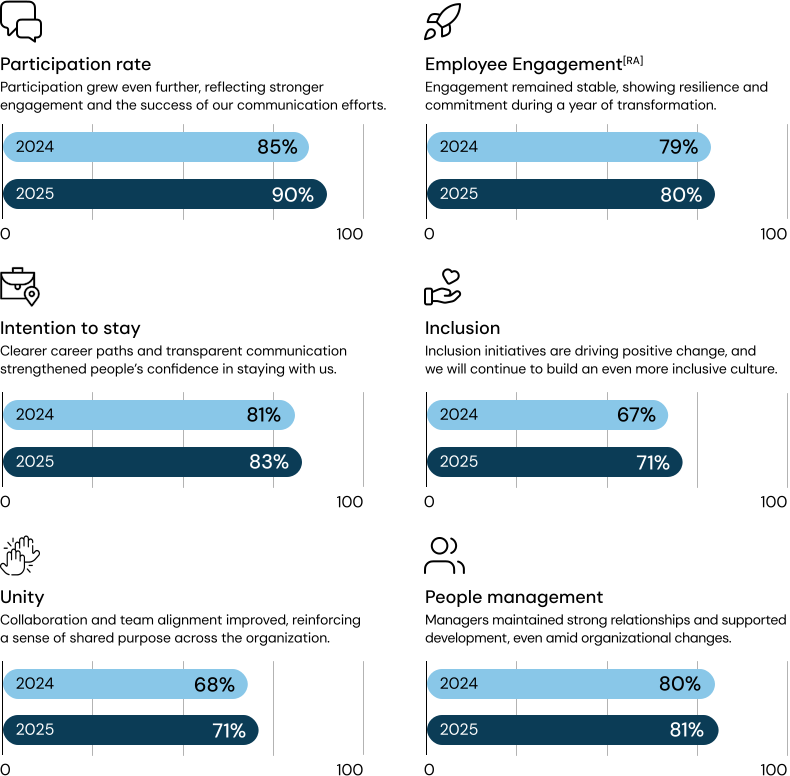
In 2025, participation reached 90%, demonstrating the strong commitment of our people to share their voices. Not only has participation increased significantly, but so has the number of people leaving their feedback and suggestions, making their voices heard with the purpose of further strengthening our company culture.
The results were shared across all layers of the company, from the global level to the team level, and led to follow-up actions. The results in 2025 show relevant progress due to the efforts across the organization, due to transparent discussions on the feedback from last year’s survey, as part of the journey to focus on embedding our values and behaviors into our culture. Additionally, we continued to prioritize well-being based on the feedback and took actions at a global and local level as described under Vitality and well-being. See more information in Metrics and targets, Inclusion and belonging.
In addition to our annual Employee Engagement Survey, we actively listen at key milestones that matter. These touchpoints allow us to capture feedback when it is most relevant and take timely action to improve employee experience, engagement, and retention, for example:
-
During recruitment: We listen to new hires and our hiring managers
-
During onboarding: We listen to people who have been in their new job for between 30 and 180 days
-
On work anniversaries: We ask people to reflect on the year and to look ahead
-
When people decide to leave: We inquire about their reasons for leaving
Looking ahead, our ambition is to transform feedback into actions that drive measurable impact and sustained performance.
We aim to turn insights into progress, building deeper trust, creating more opportunities for growth, and fostering a culture in which transparency and collaboration empower every individual to excel. By connecting feedback to tangible outcomes, we will strengthen accountability, accelerate development, and ensure that every contribution moves us closer to our shared goals.
Leadership development
Building on the foundation established in 2024, we continued to strengthen leadership capabilities across the organization through our expanded development programs.
Leading Progress and Leading Progress in operations
Following the launch of this program in June 2024, an additional 660 people managers were nominated in 2025, bringing to 26% the total proportion of our people manager population trained during 2024 and 2025. The program now has a strong regional presence and is delivered in five languages, ensuring inclusivity and accessibility.
Leading Leaders
In 2025, 151 Directors and Senior Directors were nominated to participate in Leading Leaders, reinforcing our commitment to developing leaders who can inspire, deliver, and build for the future.
Alumni initiatives
Each leadership program includes its own alumni initiative, designed to sustain growth and connection well beyond the formal experience. Both programs offer various options to continue the learning journey: leader forums, Viva Engage space with curated materials, LearnNow pathway tailored to each leadership level, and workshops. The continuing program also encourages cohorts to self-organize quarterly meetups to share insights and tackle challenges together. The benefits for participants are significant: deepening their learning, strengthening peer connections, and applying program concepts to real business cases, fostering growth in multiple dimensions and creating lasting impact.
During 2025, we also introduced online coaching for 142 leaders, providing personalized support to accelerate growth and strengthen their leadership impact. All these initiatives continue to align with our values and behaviors, empowering leaders to build high-performing teams, foster innovation, and lead authentically in a unified dsm-firmenich culture.
Reward and recognize
In 2025, we made significant progress in activating our unified global rewards framework, building on the foundations laid during 2024 and delivering on our goal to create a transparent, equitable, and performance-driven approach to rewarding and recognizing our employees worldwide.
Early 2025 saw a milestone with the successful rollout of our global job-grading system across all regions. This grading structure anchors our reward programs, ensuring fairness and clarity in how we recognize value of work and contributions.
Another highlight in 2025 was the launch of our integrated Annual Pay Review (APR) cycle, which covers over 52 countries, impacting close to 22,000 employees. People managers received training on our rewards approach so that they could make pay decisions for their teams consistently worldwide, ensuring that pay reflects each employee’s contribution and impact.
Our recognition programs launched in 2024 continued to foster engagement and collaboration across the Group during 2025. Over 14,000 Kudos Awards, a peer-to-peer recognition award, were granted across Business Units and teams to inspire individuals to go beyond. 39 individuals or teams received Progress Awards, which are given year-round as cash spot awards for extraordinary achievements or impact in their respective areas.
We advanced the harmonization of benefits across countries, balancing global consistency in our benefits principles with the flexibility to recognize local market norms. This initiative will continue through 2026 as we work to provide a harmonized, competitive, and inclusive global benefits program.
People development
Our People Progress Approach is a holistic framework that links performance, talent management, and career development in one continuous cycle. It empowers employees to take ownership of their development and personal growth, encouraging them to set objectives collaboratively with their managers, give and receive feedback, and engage in career conversations that align personal ambitions with organizational goals.
At the start of 2025, employees actively embraced the People Progress Approach introduced in 2024, setting a total of over 87,600 performance objectives. Throughout each year, ongoing dialogues between managers and employees foster alignment, enabling re-prioritization of objectives when needed. Mid-year checkpoints provide a critical opportunity to deepen feedback exchanges and focus on development, while talent reviews identify successors as well as pathways for the development of key talents.
At year-end, employees reflect on their impact and growth, engaging in conversations about objectives achieved, values demonstrated through both behaviors and outcomes, and next career steps. People managers also assess their leadership impact in line with our People Manager Fundamentals, ensuring they support growth while modelling organizational values.
In 2025, 88.5% of our employees participated in annual reviews via our global process. Overall, the People Progress Approach reflects our commitment to empowering employees, fostering open dialogue, and cultivating a culture of growth and sustainable impact.
Training and skills
In 2025, we continued to strengthen our best-in-class learning experience solution, LearnNow, a social platform that brings learning closer to every employee. Designed to inspire curiosity and collaboration, LearnNow offers access to more than 45,000 virtual courses, 16,000 business books, more than 40 academies for our Business Units and Business Partners, and company leadership programs, creating opportunities for growth across all roles and regions.
New features such as AI-powered practice chats for challenging conversations, curated book and podcast recommendations, and guided leadership paths make learning more relevant and engaging than ever. In addition, we launched a mobile version of LearnNow, making learning accessible anytime, anywhere.
Employees can find on LearnNow all resources available to support their growth at dsm-firmenich, including:
Mentoring program: Connected 394 mentees and 298 mentors across functions and regions to share expertise and accelerate development
Multi-rater (360º) feedback tool: Adopted by more than 1,000 employees and over 300 people managers, enabling diverse perspectives on strengths and areas for improvement.
Developing our technical skills through our Superhuman initiative
AI is transforming industries at an unprecedented pace, and at dsm-firmenich, we see it as a catalyst for human potential. The SuperHuman initiative is about empowering every employee with cutting-edge tools and knowledge. By integrating AI into our daily work, we simplify complex tasks, automate routine processes, and unlock new ways to make data-driven decisions.
The overall benefits of this initiative are:
Universal access: A suite of Generative AI solutions is available to all employees, democratizing advanced capabilities across the organization
Skill-building: Regular expert-led sessions provide practical tips and guidance, ensuring everyone can confidently leverage AI in their roles
Collaboration and innovation: We encourage teams to identify opportunities where AI can accelerate progress across the value chain, because the future of work is something we shape together
By embracing AI responsibly and inclusively, we are building a workforce that is future-ready. The SuperHuman initiative reflects our commitment to integrity, innovation, and the belief that technology should empower people, not overshadow them. For more information, see Data governance and AI.
Equitable living standards
We care for our employees and their families by providing them a decent standard of living through payment of a living wage. The living wage is the remuneration received for a standard working week (the relevant legal regular working hours or a maximum of 48 hours per week) by a worker in a particular place sufficient to afford a decent standard of living for the worker and their family. This includes proper access to health, food and nutrition, housing, and education. Every two years, we assess our living wage commitment using the benchmark data of WageIndicator.
In conjunction with our ongoing advocacy efforts with UNGC, WBCSD, IDH, ILO and more, living wage was, for the first time, highlighted as a priority topic by governments worldwide. This happened as part of the Doha Political Declaration that was adopted in November 2025 by the UN Second World Summit for Social Development in Qatar, reaffirming global commitments to eradicate poverty, promote full and productive employment, enable decent work for all, foster social inclusion, and now explicitly prioritize the living wage.
See our actions on advancing fair compensation beyond our workforce in Workers in the value chain.
Human rights
Across our activities and those of our supply chain, we are committed to the highest international standards in human rights. This commitment is documented in our Human Rights policy and underpinned by our Code of Business Ethics. We also have position papers on modern slavery and conflict minerals.
We believe the subject of human rights is one that should be embedded across all our business practices and processes. Once captured on paper, this needs our continued attention, as the impact only comes when it becomes embedded in our culture and behaviors. Everyone must understand how, and why, human rights matter in their day-to-day jobs. The topic of human rights is also a key focus area when working with suppliers. Via our Supplier Code and our Responsible Sourcing standard, we extend our human rights policies to suppliers and partners by requiring them to adhere to similar ethical practices. For more information on our responsible sourcing practices and our supply chain due diligence approach, see Engaging with our suppliers and Workers in the value chain.
Each year, we publish our annual Human Rights report. In the 2025 edition of this report, we highlight how we conduct due diligence, share reported cases of human rights infringements, and highlight an existing supply chain remediation case, to demonstrate how we apply our commitment to respect the highest human rights standards. The Human Rights report will be published later in 2026.
Key initiatives that took place in 2025 included the following:
We conducted a global risk assessment to identify Human Rights focus areas in our own operations and across our supply chain, in line with the UNGP and OECD guidelines. As a result, we identified the following potential human rights risks in our own operations: working conditions, discrimination, freedom of association and collective bargaining, and environmental degradation impacting human rights. In our supply chain, we identified two additional risks: child labor and forced labor. More details per focus area will be shared in our annual Human Rights report.
We started a new collaboration with our longstanding partner UNICEF to address social inequalities linked to our value chains
At the request of a customer, we were assessed regarding our own operations and the sourcing of one specific commodity, pink pepper, along with our service providers, using the Fair Labor Association (FLA) Verified Converged Human Rights and Environmental Due Diligence (HREDD) Self-Assessment Tool. We achieved an overall maturity rating of Intermediate and a percentage score of 98%. With a score of 100%, a rating of ‘advanced’ is given.
We joined the Community of Practice of the Dutch Social and Economic Council (SociaalEeconomische Raad, SER) to continue improving our own skills in conducting meaningful stakeholder dialogue and engage with other companies based in the Netherlands to exchange learnings on this topic
Our human rights performance is assessed externally by Sedex Members Ethical Trade Audit (SMETA) audits. This is an audit methodology serviced on the Sedex platform. It encompasses all aspects of responsible business practice.
To hold ourselves accountable for our performance on human rights, we set ourselves the ambition for the human rights pillar in our SMETA audits to achieve zero open critical non-conformity cases by the end of 2025. Our progress will be communicated in our Human Rights report.
To identify knowledge gaps on human rights, we held consultations across the company. Our next step is to create role-specific content and training materials to deepen employee awareness and engagement on this topic.
Safety and health
Safety, health, and well-being are the foundation of our company. Our ambition is for everyone to return home safe and healthy, every day.
As part of our SHE journey, we are strengthening our safety culture and framework through SHE leadership development, the behavior-based program SafeStart©, and the continued roll-out of our Life Saving Rules. By aligning our programs, setting clear goals, and monitoring progress with robust leading KPIs, we empower everyone to take ownership and ensure a safe, healthy workplace for all.
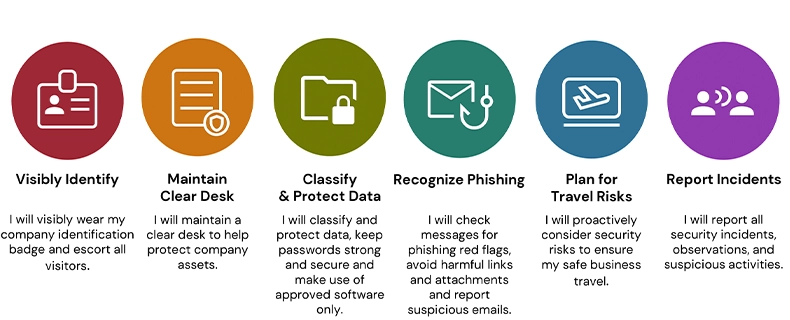
Our key security behaviors
Security
We also foster a strong security culture. We recognize that organizational resilience is built not only on systems and processes but also on the daily actions of our people. In 2025, we launched a global initiative defining six key security behaviors that empower employees to act as our ‘human firewall.’ These behaviors promote awareness, accountability, and proactive engagement in safeguarding our people, assets, and information. By embedding these principles across all our operations, we continue to strengthen our collective security posture and sustain a culture of shared responsibility.
Safety of our employees and contractors
In 2025, we continued the roll-out of Life Saving Rules across all sites, supported by targeted capability development initiatives. In addition to this, the deployment of the company SHE requirements provided a robust foundation for our SHE management framework, ensuring consistent standards and clear leadership responsibilities. Leadership played a central role by driving alignment, ensuring consistent communication of safety priorities, and fostering a culture of ownership and proactive engagement. These efforts collectively strengthened our management system and advanced our company-wide safety objectives.
Process safety
Process safety refers to the safe operational design of our facilities. In 2025, we introduced the Process Lifecycle Leadership standard and guidelines to unify practices across dsm-firmenich. Business Units launched targeted process safety programs to address key risks related to behavior and asset management, with support from company-wide initiatives. We further integrated process safety data into our digital risk assessment platform for continuous monitoring. Focused training improved competencies in managing self-heating materials, powders, and liquid blending. Business Unit program progress is actively monitored to ensure ongoing improvement and shared responsibility for process safety.
Health at Work
Health at Work in our company is built on two complementary dimensions: Industrial Hygiene and Occupational Health (IH-OH) and Vitality.
On the one hand, IH-OH focuses on managing workplace health risks such as chemical exposure, noise, and ergonomics. Industrial Hygiene aims to control these exposures at the source, while Occupational Health complements this by overseeing health surveillance. The primary goal is to prevent occupational diseases and ensure a safe workplace.
Vitality, by contrast, promotes overall well-being through programs that encourage healthy lifestyles, resilience, and psychological support, helping employees thrive beyond mere risk prevention.
Industrial Hygiene and Occupational Health
In 2025, we continued to strengthen this integrated approach across all our operations. A regional industrial hygiene organization was established to provide expert guidance on risk assessment and control, ensuring consistent, high-quality practices at our manufacturing sites worldwide. Consequently, we onboarded experienced industrial hygiene experts to further enhance our capabilities and drive continuous improvement across all regions.
Our integrated hazard and risk assessment digital platform, introduced in previous years, remained central to this strategy. This custom-built, cloud-based software ensures uniform evaluation and control of risks across all facilities. The platform covers key occupational hazards historically linked to workplace illnesses: chemicals, noise, ergonomics, and repetitive strain injuries. To further advance our approach, we have established a multiyear program aimed at extending implementation to all our sites worldwide.
We launched a comprehensive suite of internal training and qualification programs, designed to support managers, technical staff, and laboratory experts at every level of responsibility. Multiple training modules are available, each tailored in complexity to match participants’ specific health-related roles. While substantial progress has been made, full coverage is still underway, reflecting our commitment to continuously advancing health expertise throughout the organization.
The implementation of our Life Saving Rule, Safe Working with Chemicals, continued across the organization in 2025. This important standard encompasses several key elements: it requires thorough risk assessment of chemical exposures, mandates the implementation of effective controls, ensures clear hazard communication, and establishes management processes to verify that these controls remain effective over time.
As part of our management of chemical risks, we continued to strengthen our collaboration with internal toxicologists to gather data on the toxicity of the chemicals we use. This ongoing partnership enables us to set mandatory internal occupational exposure limits that exceed legal requirements and help us determine safe exposure levels for laboratory chemicals and panelist tasks.
At the same time, we introduced a new company standard for respiratory protective equipment. While respirators are not our primary means of controlling exposures to chemicals, this standard ensures correct selection, maintenance, and use whenever needed, adding an extra layer of protection.
Our ergonomic program maintained the deployment of wearable devices at designated locations. These devices monitor employees’ movements and deliver immediate feedback, promoting safer lifting practices and minimizing ergonomic risks. We have also piloted the use of artificial intelligence for ergonomic assessments at certain locations and will continue to implement this technology at selected sites.
This innovative approach enables a more detailed evaluation of our tasks, further supporting the effectiveness of our ergonomic initiatives. In addition, we successfully completed a campaign in some of our production sites that focused on implementing minimum controls to enhance manual handling. As part of this initiative, we introduced solutions such as lifting tables and hoists, which contribute to reducing the physical strain associated with manual lifting and help create a safer work environment.
Together, these efforts reinforce a proactive health culture that integrates risk management, medical oversight, and holistic well-being, supporting our employees and sustaining high operational performance.
Vitality and well-being
2025 was a year of consistent action and connection. We launched exciting new vitality lifestyle challenges that brought thousands of colleagues together worldwide, and strengthened our Mental Fitness Champions community with fresh tools and programs.
We partner across the company to amplify well-being initiatives globally and continue to build a culture of health, making dsm-firmenich a workplace with a positive impact on health, and vitality.
Collaboration across Business Units:
TTH hosted webinars on hydration and sports nutrition (co-developed with Team Picnic PostNL)
HNC organized a global webinar on gut health and its link to vitality
P&B created content supporting its mission of improving well-being
Boost Your Vitality
We celebrated more than 7,000 sign-ups for our Boost Your Vitality program, empowering colleagues to make healthier choices every day. Our Global Team Step challenge brought together nearly 2,000 participants across 43 countries, while the Tour de dsm-firmenich Cycling challenge inspired over 200 riders in 32 countries.
We expanded our webshop with sports nutrition supplements co-developed by dsm-firmenich scientists and Team Picnic PostNL, and introduced innovative products such as Quali-C, Vegan Omega-3, and ampli®-D to our three regional flagship restaurants in Maastricht, Geneva, and Kaiseraugst. To keep our global community informed and inspired, we continued delivering Global Vitality Office and Boost Your Vitality newsletters packed with practical tips, updates, and insights.
Mental Health
Over 580 Mental Fitness Champions have been certified worldwide. The Mental Fitness in Practice program was introduced as a preventive initiative, equipping these Champions with practical tools and the confidence needed to support colleagues at an early stage where needed. In addition, webinars were delivered on key topics such as burnout prevention and overcoming mental health barriers.
Visibility and accessibility of support were further enhanced through the launch of the Mental Fitness Champions Directory on the Vitality Boost app. Furthermore, a mental well-being check-in was introduced, enabling employees to assess their mental fitness proactively and to access tailored resources and support in a timely manner. Our Mental Well-being Walk and Talk Challenge brought together 595 participants across 40 countries.
Metrics and targets
We have set targets across multiple areas to address the relevant impacts, risks, and opportunities for our workforce:
Safety: Our long-term Total Recordable Incident Rate, TRIR, target level is 0.20
Diversity in the Global Management Team (GMT): Reach 36% female or non-binary and 41% non-western European background colleagues through self-identification.
Employee engagement and inclusion: Measure engagement scores of employees self-identifying as minorities; focus on creating a workplace where everyone feels valued and heard; annually measure our overall engagement score; drive focused action planning across our Business Units and Business Partners, report target levels for employee engagement and inclusion.
Living wage: We commit to pay a living wage to all our employees in our own operations
Gender pay equity: We commit to deliver gender pay equity across the different levels of our workforce.
|
|
Target |
|
2025 |
|
2024 |
||||||||||
|---|---|---|---|---|---|---|---|---|---|---|---|---|---|---|---|---|
Frequency index Total Recordable Incident Rate[RA] |
|
0.20 by 2030 |
|
0.26 |
|
0.24 |
||||||||||
Gender diversity in the GMT[RA] |
|
36% by 2025 |
|
35% |
|
-1 |
||||||||||
Non-western European diversity in the GMT[RA] |
|
41% by 2025 |
|
48% |
|
-1 |
||||||||||
Employee engagement[RA] |
|
80% by 2030 |
|
80% |
|
79% |
||||||||||
Inclusion |
|
70% by 2030 |
|
71% |
|
67% |
||||||||||
Employees paid below benchmark2 |
|
0 |
|
0 |
|
0 |
||||||||||
Unadjusted gender pay gap3 |
|
<5.0% |
|
-8.2% |
|
-6.1% |
||||||||||
Adjusted gender pay gap |
|
|
|
3.3% |
|
–4 |
||||||||||
|
||||||||||||||||
In 2025, our TRIR[RA] was 0.26. This is a slight decline versus the 2024 performance of 0.24, but on track toward our target level. Much of this decline resulted from a weaker first half of the year.
In 2025, participation in the Employee Engagement survey (EES) reached 90%, Employee engagement[RA] resulted in 80% and inclusion in 71%. GMT
Diversity in the GMT[RA] was measured at the end of 2025, achieving 35% leaders who identified as women & non-binary and 48% identified as non-western European background.
In 2025, no employees were paid under the adequate wage. In 2024, no employees were paid below a living wage. The next living wage assessment will be performed in 2026.
On gender pay equity, the unadjusted gender pay gap was 8.2% in favor of women. This figure does not distinguish between the different job levels of our organization. When adjusting for the job levels of our organization, the adjusted gender pay gap is 3.3% in favor of men.
Characteristics of our employees
All characteristics are reported on a (percentage of) headcount basis. Headcount reporting on our employees is also included in Note 4 Segment information to the Consolidated Financial Statements.
|
|
2025 |
|
2024 |
|---|---|---|---|---|
Male |
|
18,132 |
|
17,968 |
Female |
|
10,406 |
|
10,242 |
Not disclosed/unknown |
|
12 |
|
4 |
Total employees |
|
28,550 |
|
28,214 |
Employees by contract type
Temporary contracts are used within the company to backfill absences and temporary leave, address peak workload periods, and comply with country-specific practices for probation periods. It also includes all students, trainees and internships.
|
|
Female |
|
Male |
|
Not disclosed/ |
|
Total |
|---|---|---|---|---|---|---|---|---|
2025 |
|
|
|
|
|
|
|
|
Permanent |
|
9,197 |
|
16,097 |
|
12 |
|
25,306 |
Temporary |
|
807 |
|
870 |
|
0 |
|
1,677 |
Non-guaranteed hours |
|
0 |
|
0 |
|
0 |
|
0 |
Non-integrated acquisitions |
|
402 |
|
1,165 |
|
0 |
|
1,567 |
Total |
|
10,406 |
|
18,132 |
|
12 |
|
28,550 |
Full-time |
|
8,939 |
|
16,419 |
|
12 |
|
25,370 |
Part-time |
|
1,065 |
|
548 |
|
0 |
|
1,613 |
|
|
|
|
|
|
|
|
|
2024 |
|
|
|
|
|
|
|
|
Permanent |
|
8,897 |
|
15,814 |
|
4 |
|
24,715 |
Temporary |
|
932 |
|
981 |
|
0 |
|
1,913 |
Non-guaranteed hours |
|
0 |
|
0 |
|
0 |
|
0 |
Non-integrated acquisitions |
|
413 |
|
1,173 |
|
0 |
|
1,586 |
Total |
|
10,242 |
|
17,968 |
|
4 |
|
28,214 |
Full-time |
|
8,740 |
|
16,247 |
|
4 |
|
24,991 |
Part-time |
|
1,089 |
|
548 |
|
0 |
|
1,637 |
|
|
Netherlands |
|
Switzerland |
|
Rest of EMEA |
|
North America |
|
Latin America |
|
China |
|
Rest of Asia |
|
Total |
|---|---|---|---|---|---|---|---|---|---|---|---|---|---|---|---|---|
2025 |
|
|
|
|
|
|
|
|
|
|
|
|
|
|
|
|
Permanent |
|
1,678 |
|
3,550 |
|
7,718 |
|
4,187 |
|
3,356 |
|
1,746 |
|
3,071 |
|
25,306 |
Temporary |
|
85 |
|
128 |
|
594 |
|
17 |
|
221 |
|
504 |
|
128 |
|
1,677 |
Non-guaranteed hours |
|
0 |
|
0 |
|
0 |
|
0 |
|
0 |
|
0 |
|
0 |
|
0 |
Non-integrated acquisitions |
|
0 |
|
0 |
|
125 |
|
0 |
|
0 |
|
1,074 |
|
368 |
|
1,567 |
Total |
|
1,763 |
|
3,678 |
|
8,437 |
|
4,204 |
|
3,577 |
|
3,324 |
|
3,567 |
|
28,550 |
Full-time |
|
1,276 |
|
3,213 |
|
7,754 |
|
4,187 |
|
3,500 |
|
2,250 |
|
3,190 |
|
25,370 |
Part-time |
|
487 |
|
465 |
|
558 |
|
17 |
|
77 |
|
0 |
|
9 |
|
1,613 |
|
|
|
|
|
|
|
|
|
|
|
|
|
|
|
|
|
2024 |
|
|
|
|
|
|
|
|
|
|
|
|
|
|
|
|
Permanent |
|
1,675 |
|
3,613 |
|
7,399 |
|
4,137 |
|
3,324 |
|
1,587 |
|
2,980 |
|
24,715 |
Temporary |
|
101 |
|
121 |
|
602 |
|
18 |
|
241 |
|
688 |
|
142 |
|
1,913 |
Non-guaranteed hours |
|
0 |
|
0 |
|
0 |
|
0 |
|
0 |
|
0 |
|
0 |
|
0 |
Non-integrated acquisitions |
|
0 |
|
0 |
|
133 |
|
0 |
|
0 |
|
1,090 |
|
363 |
|
1,586 |
Total |
|
1,776 |
|
3,734 |
|
8,134 |
|
4,155 |
|
3,565 |
|
3,365 |
|
3,485 |
|
28,214 |
Full-time |
|
1,265 |
|
3,270 |
|
7,438 |
|
4,139 |
|
3,489 |
|
2,275 |
|
3,115 |
|
24,991 |
Part-time |
|
511 |
|
464 |
|
563 |
|
16 |
|
76 |
|
0 |
|
7 |
|
1,637 |
|
|
2025 |
|
2024 |
||||||||||||||||
|---|---|---|---|---|---|---|---|---|---|---|---|---|---|---|---|---|---|---|---|---|
|
|
Female |
|
Male |
|
Not disclosed/ |
|
Total |
|
Female |
|
Male |
|
Not disclosed/ |
|
Total |
||||
Inflow1 |
|
|
|
|
|
|
|
|
|
|
|
|
|
|
|
|
||||
Total number of new hires (excluding acquisitions) |
|
1,644 |
|
2,313 |
|
14 |
|
3,971 |
|
1,166 |
|
1,852 |
|
2 |
|
3,020 |
||||
Acquisitions |
|
0 |
|
0 |
|
0 |
|
0 |
|
0 |
|
21 |
|
0 |
|
21 |
||||
Total inflow |
|
1,644 |
|
2,313 |
|
14 |
|
3,971 |
|
1,166 |
|
1,873 |
|
2 |
|
3,041 |
||||
|
|
|
|
|
|
|
|
|
|
|
|
|
|
|
|
|
||||
% new hires by region |
|
|
|
|
|
|
|
|
|
|
|
|
|
|
|
|
||||
Netherlands |
|
2.1% |
|
2.6% |
|
0.0% |
|
4.9% |
|
1.6% |
|
2.9% |
|
0.0% |
|
4.5% |
||||
Switzerland |
|
2.7% |
|
5.3% |
|
0.0% |
|
8.3% |
|
3.6% |
|
6.0% |
|
0.0% |
|
9.6% |
||||
Rest of EMEA |
|
13.9% |
|
18.6% |
|
0.0% |
|
32.5% |
|
13.4% |
|
17.7% |
|
0.0% |
|
31.1% |
||||
North America |
|
7.2% |
|
11.6% |
|
0.4% |
|
19.5% |
|
7.0% |
|
14.0% |
|
0.1% |
|
21.1% |
||||
Latin America |
|
6.8% |
|
10.2% |
|
0.0% |
|
17.3% |
|
4.6% |
|
10.2% |
|
0.0% |
|
14.8% |
||||
China |
|
2.6% |
|
3.2% |
|
0.0% |
|
5.5% |
|
2.1% |
|
2.9% |
|
0.0% |
|
5.0% |
||||
Rest of Asia |
|
6.1% |
|
6.7% |
|
0.0% |
|
12.0% |
|
6.1% |
|
7.9% |
|
0.0% |
|
14.0% |
||||
|
|
|
|
|
|
|
|
|
|
|
|
|
|
|
|
|
||||
Outflow |
|
|
|
|
|
|
|
|
|
|
|
|
|
|
|
|
||||
Voluntary resignations |
|
863 |
|
1,230 |
|
4 |
|
2,097 |
|
696 |
|
1,190 |
|
3 |
|
1,889 |
||||
Total outflow (excluding divestments) |
|
1,384 |
|
2,036 |
|
12 |
|
3,432 |
|
975 |
|
1,851 |
|
4 |
|
2,830 |
||||
Divestments |
|
58 |
|
106 |
|
0 |
|
164 |
|
451 |
|
1,017 |
|
0 |
|
1,468 |
||||
Total outflow |
|
1,442 |
|
2,142 |
|
12 |
|
3,596 |
|
1,426 |
|
2,868 |
|
4 |
|
4,298 |
||||
|
|
|
|
|
|
|
|
|
|
|
|
|
|
|
|
|
||||
Voluntary turnover (%)1 |
|
6.6% |
|
6.1% |
|
|
|
6.3% |
|
7.5% |
|
7.2% |
|
|
|
7.3% |
||||
Total turnover (%)1 |
|
9.9% |
|
10.2% |
|
|
|
10.1% |
|
10.5% |
|
11.2% |
|
|
|
10.9% |
||||
|
||||||||||||||||||||
Collective bargaining
The coverage by region of collective bargaining agreement is based at country level, and is reported through our regional human resources organization. At least 43% of employees are covered by collective bargaining agreements (2024: at least 43%), and a European Works Council is in place. As dsm-firmenich has no EEA countries meeting the ESRS thresholds, the total EEA percentage is reported.
Collective bargaining coverage |
|
Social Dialogue |
||||||||||||
|---|---|---|---|---|---|---|---|---|---|---|---|---|---|---|
|
Employees EEA2 |
|
Employees Non-EEA |
|
Workplace representation (EEA only)2 |
|||||||||
0–19% |
|
|
|
|
|
|
||||||||
20–39% |
|
|
|
|
|
|
||||||||
40–59% |
|
|
|
|
|
|
||||||||
60–79% |
|
|
|
|
|
|
||||||||
80–100% |
|
|
|
|
|
|
||||||||
|
||||||||||||||
Training and skills
In 2025, learning engagement remained strong, with consumption reaching over 100,000 hours. We encourage sustainable learning: for every 10 hours of digital learning in which our employees engage, we plant a tree. Prior to 2025, we planted over 30,000 trees, and in 2025, we added 10,000 further trees, reinforcing our commitment to both personal growth and environmental responsibility.
Health and safety
In 2025, more than 170 locations were incident-free for more than a year. The total number of safety incidents increased in 2025 compared to 2024, much of this due to a weaker first half of the year. The stronger results in the second half of the year suggest that the introduced initiatives are beginning to have an effect.
In 2025, we recorded 97 incidents (2024: 87), corresponding with a TRIR[RA] (employees and contractors, excluding recent acquisitions) of 0.26, (2024: 0.24). This is equivalent to an ESRS-aligned 1.3 recordable work-related accidents per 1 million hours worked (2024: 1.24). There were 36 work-related ill health cases (employees and contractors, 2024: 35). This corresponds to a Health Rate of 0.10.
Tragically, we incurred a fatal incident in 2025, in which an Account Manager in our NA ANH Business Team was involved in an accident during a customer visit. The accident was caused by a third person who is being prosecuted for involuntary manslaughter by the authorities. dsm-firmenich was not penalized for any safety violation associated with the tragic incident. This loss has deeply impacted our organization and reinforces our commitment to safety.
In 2024, dsm-firmenich recorded one fatality from work-related injuries.
In total, there were 6,092 days lost (2024: 3,789) to work-related injuries (excluding the fatality) and ill-health (employees & supervised contractors). All employees are covered by our health and safety management systems, which are based on local, national and international regulations, international standards such as ISO 45001 as well as best practices and our own policies.
Our Process Safety Incident (PSI) rate for 2025 was 0.30, comparable to the 2024 level of 0.31. For process safety, targeted improvement programs were implemented at sites with the highest incident rates, and new behavior-based initiatives were launched to address root causes. We continued to conduct fire protection integrity assessments globally, underscoring our commitment to protecting people and assets from fire and natural hazards.
Compensation-related metrics
Adequate wages
We are committed to providing a decent standard of living for our employees and their families and we provide all our employees with fair wages. Our wage practices are aligned with national regulations and international standards to ensure fair and equitable compensation. In 2025, no employee was paid under the adequate wage. A living wage assessment analysis will be conducted in 2026.
Gender pay gap
We are committed to creating an inclusive workplace where all employees are rewarded equitably. The unadjusted gender pay gap measures the difference in average earnings between men and women across the organization, regardless of role or seniority.
In 2025, our analysis showed an unadjusted gender pay gap of 8.2% in favor of women, meaning that, on average, female earned 108.2% of the pay level of men. When adjusting for the levels of our organization, the adjusted gender pay gap is 3.3% in favor of men. The difference between the adjusted and unadjusted pay gap is due to more female representation in the management levels of the organization as compared to other more junior levels.
|
|
2025 |
|
2024 |
||||||
|---|---|---|---|---|---|---|---|---|---|---|
Employees paid below benchmark |
|
0 |
|
0 |
||||||
Unadjusted gender pay gap1 |
|
-8.2% |
|
-6.1% |
||||||
Adjusted gender pay gap |
|
3.3% |
|
–2 |
||||||
Remuneration ratio |
|
86.7 |
|
71.7 |
||||||
|
||||||||||
Annual total remuneration ratio
The ratio of the annual total compensation for the organization’s highest-paid individual (our CEO) to the median annual total compensation for all permanent dsm-firmenich employees (excluding the highest-paid individual), is referred to as the “Remuneration ratio”.
The CEO’s total compensation in 2025 was €6,990,781 (2024: €5,518,160) whereas the median 2025 compensation for permanent employees was €80,586 (2024: €76,914). This results in a remuneration ratio for 2025 of 86.7 compared to 71.7 in 2024. The difference is driven by the annual cash incentives. The portion of the cash incentive (STI) in the Total Direct Compensation is higher for the CEO than for the median employee, resulting in a greater impact on the numerator compared to the denominator.
If the remuneration ratio considered average employee remuneration (€110,258 compared to €100,864 in 2024) rather than the median, the ratio would amount to 63.4 (2024: 54.7).
For the calculation of the remuneration ratio, the total compensation of the CEO is calculated based on the same assumptions as for all other employees (described in the methodology); the amount therefore differs from the Compensation report. Main differences concern the STI (STI paid in 2025 achieved over 2024 versus the STI accrued in 2025 in the Compensation report) and the LTI (fair value versus face value used in the Compensation report).
Any comparison over time and/or between companies should be made with great caution and restraint. Companies may use different calculation methods, and their geographical footprint may also vary significantly. The outcome of the remuneration ratio is largely determined by the share of variable remuneration (STI and LTI) in total remuneration. The proportion of variable remuneration (i.e., remuneration at risk) in total remuneration increases for higher job classes and amounts (at target) to 75% of the CEO’s total direct compensation. Additionally, remuneration structures may differ by country and acquisitions, divestments, growth or decline in certain areas and exchange rate fluctuations will also affect the remuneration ratio.
The results of our 2025 Employee Engagement Survey
Inclusion and belonging
This year, we exceeded our 70% inclusion target, achieving a score of 71% in our annual Employee Engagement Survey (EES).
Currently, 36.4% of employees at dsm-firmenich are women, contributing across all functions and geographies. Within the Board of Directors, which comprises 11 members representing 8 nationalities, 36% are women. At the executive level, 3 out of 9 Executive Committee members are women, reinforcing our commitment to balanced leadership.
We embed representation targets for women, non-binary individuals, and ethnically diverse leaders into our LTI plan, making inclusion a measurable priority at the highest level. In 2025, 35% of our Global Management Team[RA] identified as women or non-binary, positioning us close to our 36% target, while 48% identified with a non-western European background, exceeding our 41% target. These outcomes reflect more than numbers: it demonstrates how linking inclusion to performance creates real impact, strengthens leadership representation, and fuels innovation and sustainable growth across our global organization.
Diversity metrics
All characteristics are reported on a (percentage of) headcount basis. Headcount reporting on our employees is also included in Note 4 Segment information to the Consolidated Financial Statements.
Temporary contracts are used within the company to backfill absences and temporary leave, cover peak workload periods, and address country-specific practices for probation periods. It also includes all students, trainees and internships.
|
|
Executives1 |
|
Management1 |
|
Other1 |
|
Non-integrated acquisitions |
||||
|---|---|---|---|---|---|---|---|---|---|---|---|---|
2025 |
|
|
|
|
|
|
|
|
||||
Female |
|
139 | 31.7% |
|
5,039 | 43.2% |
|
4,826 | 32.4% |
|
402 | 25.7% |
||||
Male |
|
299 | 68.3% |
|
6,615 | 56.7% |
|
10,053 | 67.5% |
|
1,165 | 74.3% |
||||
Not disclosed/unknown |
|
0 | 0.0% |
|
4 | 0.0% |
|
8 | 0.1% |
|
0 | 0% |
||||
Total |
|
438 | 100% |
|
11,658 | 100% |
|
14,887 | 100% |
|
1,567 | 100% |
||||
|
|
|
|
|
|
|
|
|
||||
2024 |
|
|
|
|
|
|
|
|
||||
Female |
|
140 | 31.3% |
|
4,936 | 43.1% |
|
4,753 | 32.3% |
|
413 | 26.0% |
||||
Male |
|
307 | 68.7% |
|
6,526 | 56.9% |
|
9,962 | 67.7% |
|
1,173 | 74.0% |
||||
Not disclosed/unknown |
|
0 | 0% |
|
2 | 0.01% |
|
2 | 0.01% |
|
0 | 0% |
||||
Total |
|
447 | 100% |
|
11,464 | 100% |
|
14,717 | 100% |
|
1,586 | 100% |
||||
|
||||||||||||
|
|
<30 years |
|
30–50 years |
|
>50 years |
|---|---|---|---|---|---|---|
2025 |
|
|
|
|
|
|
Female |
|
1,799 |
|
6,626 |
|
1,981 |
Male |
|
2,344 |
|
11,088 |
|
4,700 |
Not disclosed/unknown |
|
6 |
|
4 |
|
2 |
Total |
|
4,149 |
|
17,718 |
|
6,683 |
|
|
|
|
|
|
|
2024 |
|
|
|
|
|
|
Female |
|
1,913 |
|
6,422 |
|
1,907 |
Male |
|
2,360 |
|
10,978 |
|
4,630 |
Not disclosed/unknown |
|
3 |
|
1 |
|
0 |
Total |
|
4,276 |
|
17,401 |
|
6,537 |
Incidents and human rights impacts
Information on incidents is reported in Speaking Up in the Business Ethics section. In 2025, three cases of incidents related to human rights were reported, two of which were unsubstantiated. Another one is still in progress. Moreover, there were 72 alleged cases of incidents (2024: 52) of discrimination and harassment. 60 cases were closed, 14 of these cases (2024: 12) were substantiated. Additional reporting relating to human rights due diligence is published separately in our Human Rights report.
We operate in geographies with higher risks of human rights incidents. Based on the assessment of our geographies and the Sedex risk register, a high risk of child labor is identified in East Asia, and of compulsory labor or forced labor in East Asia, West Asia, South Asia, and Southeast Asia. No severe human rights incidents or fines, sanctions or compensation relating to human rights incidents in our own workforce were reported in 2025.