

Materiality assessment process
The materiality assessment is an annual process. It begins with an evaluation of the business context to identify if material changes have occurred. If none have occurred, the previous conclusions are re-assessed. If material changes have occurred, a full materiality assessment is performed.
The assessment of potential and actual positive and negative IROs, including applied thresholds, is based on current guidance documents relating to the assessment, such as the Materiality Assessment Implementation Guidance by EFRAG.
As the 2024 materiality assessment was based on the conclusions of the 2023 materiality assessment, these conclusions were considered to be no longer current, and a full reassessment was performed.
Scoring and thresholds
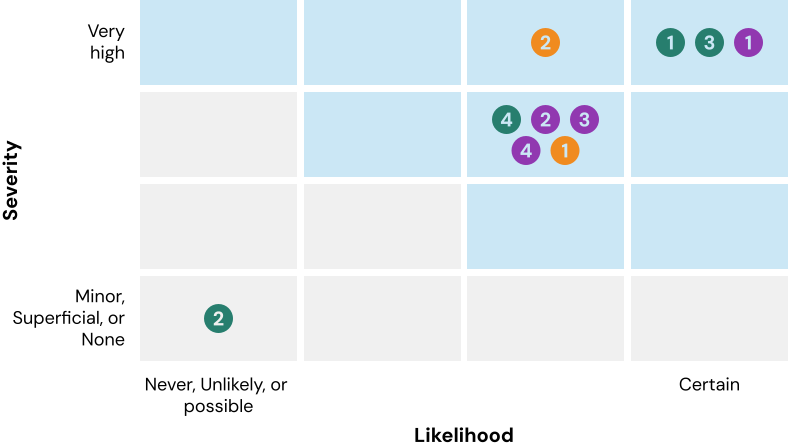
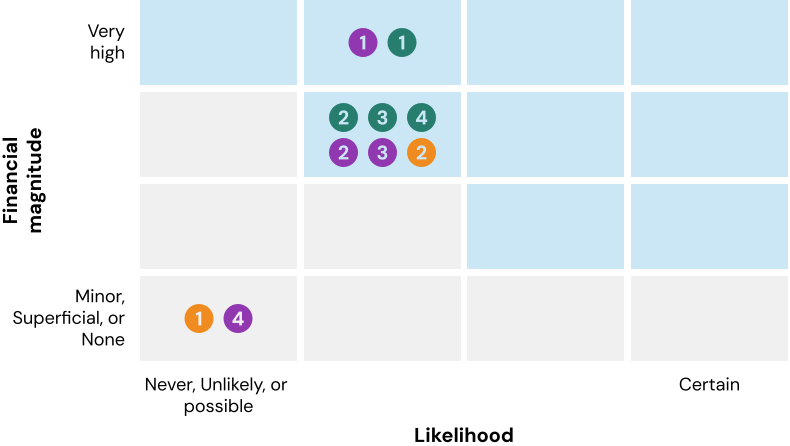
The materiality threshold is depicted in blue in the accompanying heatmaps. Topics are positioned in the heatmaps based on their highest-scoring IRO.
For visualization purposes, scores below two have been clustered. On the x-axis, this includes the scores for Never, Unlikely and Possible. On the y-axis, for Minor, Superficial and None.
Impact materiality
Impact materiality is scored on severity and likelihood, using a zero-to-five-point scale. Severity is calculated based on:
Scale: None to absolute
Scope: None to global/total
Irremediability (for negative impacts only): Very easy to irremediable/irreversible
Likelihood is scored from never to certain. For potential negative human rights impacts, severity takes precedence over likelihood.
Impact materiality heatmap
Financial materiality
Financial materiality is scored on financial magnitude and likelihood using a zero-to-five-point scale. The Financial magnitude scale is consistent with the financial impact scale as used in the Enterprise Risk Management approach. Likelihood is scored from never to certain.
Financial materiality heatmap
The 2025 DMA process consisted of seven steps
1. Value chain definition
The DMA process began with an assessment of the value chain of the company, from raw material extraction to end of life. The differences in the value chains of our Business Units were taken into consideration, based on the NACE codes related to our suppliers and customers. The dsm-firmenich value chain is depicted elsewhere in this section.
2. Definition of impact narratives
A long list of possible (positive and negative) impacts was defined using the value chain stages, the sustainability matters defined in the ESRS, and any entity-specific topics that were identified. AI was utilized to support the definition of this list, screening thousands of reports and documents relevant to our industry, value chains, and business context. The AI model was trained using guidance and standards relating to the Double materiality assessment to define the identification process, and provided with company-specific information, such as NACE codes associated with our suppliers and our customers to define narratives and preliminary impacts. All narratives were on a gross basis.
3. Initial IRO evaluation
Risks and opportunities were defined based on risks and opportunities identified in the Enterprise Risk Management process. Additional opportunities were defined based on desk research of the businesses. For impacts, the initial scoring of scale, scope and irremediability was supported and contextualized by AI. Thresholds used for the scoring were consistent with those used in our Enterprise Risk Management process. The human rights clause in ESRS 1 paragraph 45 was applied to all social topics, meaning that likelihood was not considered for these IROs.
4. DMA calibration
More than 10 workshops were conducted to review the resultant IROs and to validate the AI-supported scoring of scale, scope and irremediability. Participants consisted of:
Subject-matter experts, who were engaged in impact workshops on their area of expertise
Risk managers, who were engaged in risk and opportunity workshops based on the risk management process, as well as workshops to align on applicable thresholds
Reporting experts, who were engaged in all workshops, to provide consistency across topics, and continuity from previous materiality exercises
5. Management validations
Validation sessions were conducted with the Sustainability Committee of the Board of Directors and the Executive Committee, to obtain feedback, and to apply any required management corrections. A management decision was made to remove a proposed risk related to the material topic ‘corporate culture’, as this was assessed as not meeting the reporting thresholds in the risk management process, which resulted in this topic shifting from Double materiality to Impact materiality.
6. Stakeholder dialogue
External stakeholder interviews were conducted with investor and business representatives and with NGOs to review the process and outcome of our materiality assessment, and to discuss the industry applicability of the materiality assessment in general. We did not explicitly consult with affected communities as this was not considered necessary. No changes to the IROs or material topics were made as a result of the stakeholder dialogues. The stakeholders confirmed the robustness of the executed process, and provided direction on areas that needed further explanation, such as:
The use of AI in the process
The gross versus net perspective
7. Final approval
The results of the materiality assessment process were ultimately approved by the Executive Committee, acting on authority delegated by the Board of Directors.
Other considerations
Artificial Intelligence (AI)
This is the first year that dsm-firmenich applied AI to the materiality assessment process. It enabled an efficient and consistent approach to the assessment, looking at the complexity of our value chains and the scope of topics to be covered, and addressing the gross perspective from an industry level.
In general, the AI-generated output was considered to be of good quality. All AI-generated output was reviewed and validated by experts to ensure the accuracy and relevance of the conclusions.
Net versus gross
The assessment of negative impacts and risks was based on a gross perspective, therefore any mitigating actions or management systems that dsm-firmenich has in place were not taken into consideration. This was challenging for many workshop participants and many of our stakeholders to contextualize.
The IROs presented in the Sustainability Statements are on a gross perspective, and do not reflect the net situation in the company or our value chains. The actions and systems in place are included as part of the actions and resources reported throughout the Statements.
The gross perspective also places limitations on the applicability of the materiality assessment results for our strategy and business planning, as these are generally based on the net or expected perspective.
Integration with enterprise risk management
The 2025 DMA process was conducted in parallel to the enterprise risk management process, with the risks and opportunities identified in the latter process leading. Thresholds applied in the materiality assessment were consistent with the enterprise risk management thresholds.
ANH carve-out
Our ANH Business Unit performed an independent materiality assessment to inform itself of the topics that will be material to it in preparation for the carve-out. The results of this assessment were considered in the preparation of the dsm-firmenich materiality matrix. However, ANH-related IROs were not considered material for the company beyond the short-term time horizon.
Assessment results
In general, the areas covered by the material topics have not changed significantly compared to 2023. The bottom-up identification process for the IROs resulted in the identification or removal of financial or impact materiality for some topics. While the processes differed significantly year-on-year, an indicative mapping of the changes in the material topics is provided.
|
|
2025 Topics |
|
2024 Topics |
|
Material ESRS sub-topics |
|---|---|---|---|---|---|---|
|
|
Biodiversity and nature |
|
|
|
|
|
|
Climate change adaptation |
|
|
|
|
|
|
Climate change mitigation |
|
|
|
|
|
|
Water management |
|
|
|
|
|
|
Access to health and nutrition solutions |
|
|
|
|
|
|
Inclusion and belonging |
|
|
|
|
|
|
Labor conditions and human rights |
|
|
|
|
|
|
Occupational health and safety |
|
|
|
|
|
|
Corporate culture |
|
|
|
|
|
|
Product quality, safety, and impact |
|
|
|
|


