

Sustainable and resilient supply chains begin with responsible partners. As such, Responsible Sourcing is a strategic enabler of sustainable value creation across our value chains.
Actions and resources
Our engagement spans the dimensions of both People and Planet. On the social side, we promote safe and fair working conditions, human rights protections, and ethical labor practices. On the environmental front, we collaborate with suppliers to reduce emissions, enhance data transparency and quality, and drive initiatives that protect biodiversity, safeguard water resources and prevent pollution.
Our Responsible Sourcing Framework, deployed by our dedicated Responsible Sourcing team, ensures alignment of our actions in the upstream supply chain with our sustainability objectives and embeds responsible practices into sourcing decisions. The framework is built on three integrated layers and supported by our Join Forces Supplier Engagement Program, which drives collaboration across upstream supply chain to amplify positive impact.
Our Responsible Sourcing Framework
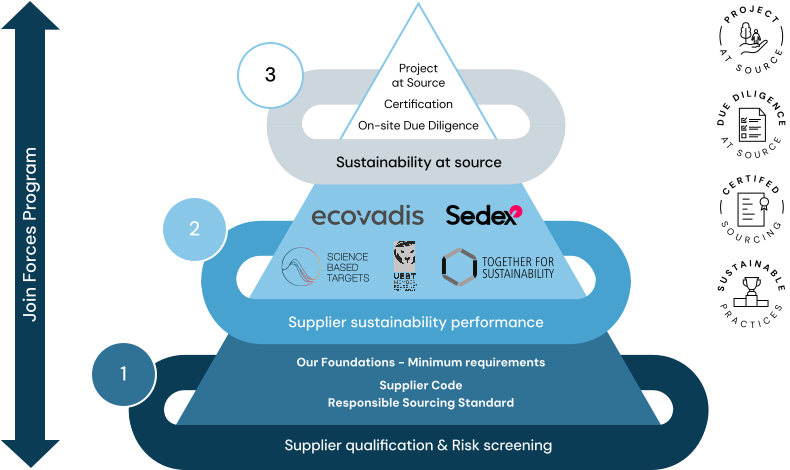
Supplier qualification and inherent risk identification
Risk mitigation is embedded throughout our engagement lifecycle, from initial supplier screening to ongoing performance monitoring via dashboards and reports.
Through our Responsible Sourcing Standard, we set clear expectations for suppliers regarding human rights, climate and nature action, and ethical business conduct. This Standard complements our Supplier Code, and together they form the foundation of our supplier engagement.
To proactively identify and mitigate sustainability risks across our supply base, we employ a robust risk screening methodology that leverages IQ+ from EcoVadis, UEBT Grove, and Sedex risk assessment platforms. These tools provide insights into supplier exposure to environmental, human rights, and ethical risks. IQ+ offers AI-driven risk scores based on supplier category, geography, and sector, while UEBT focuses on biodiversity and ethical sourcing risks for natural ingredients. Sedex complements this with social compliance data and audit findings. In 2025, we achieved sustainability risk screening of 94% of our procurement spend, across both direct and indirect categories, progressing on track toward our journey to screen our supplier’s inherent sustainability risk, a milestone that reflects our commitment to comprehensive due diligence.
Supplier sustainability performance and at-source engagement
We next assess and audit our suppliers’ sustainability performance through a combination of on-site and desktop tools as required by the level of risk identified, supported by internal capabilities and third-party assessments and audits such as EcoVadis Ratings, Sedex SMETA, and SBTi. In 2025, recognizing that comprehensive data is essential for informed decision-making, we enriched our ecosystem with additional third-party assessments and certifications such as with TfS (Together for Sustainability) audits, B Corp certifications, and EcoVadis Vitals, creating a category-tailored view of suppliers’ performances. These tools are fully embedded into our Procurement team’s digital systems and provide real-time visibility into ESG risks and opportunities, enabling us to prioritize engagement accordingly.
Our Responsible Sourcing team includes a dedicated at‑source team that audits key supply chains identified as high risk and supports our participation in relevant risk remediation coalitions. Throughout the year, the team conducts on-site due‑diligence activities, develops and follows up on remediation action plans, and ensures ongoing monitoring and communication with suppliers and stakeholders.
Supplier risks remediation
We leverage findings from assessments, audits, and inherent risk screenings to deploy tailored corrective action plans, targeted training campaigns, and decarbonization roadmaps that reflect each supplier’s capabilities and confirmed risk profile. High-risk suppliers are prioritized for root cause analysis and mitigation action planning, with Sourcing and Responsible Sourcing teams jointly leading these efforts.
When risk remediation requires collective action, we actively participate in responsible sourcing coalitions. See Workers in the value chain for more information.
Join Forces for Responsible Supply Chains
Our Join Forces program is designed to build capacity, share best practices, and accelerate progress in human rights, environmental stewardship, and transparency. This program fosters open dialogue and joint action plans, supporting all the layers of our framework.
In this context, we recently joined AIM-Progress, a global forum of companies dedicated to sustainable practices. This membership enables further alignment with international standards, participation in shared audits, and industry-wide collaboration to tackle systemic challenges. By joining AIM-Progress, we also strengthen our ability to harmonize expectations, drive consistency, and scale impact across the consumer goods sector.
Furthermore, as an active member of TfS, we leverage shared insights and actions to enhance ESG understanding and drive collective initiatives such as supplier data collection and upskilling.
We also participate in initiatives such as the Sustainable Vanilla Initiative and the UN Global Compact (UNGC) Decent Work Platform. Please refer to Workers in the value chain for UNGC initiatives collaboration achievements.
We also actively engage in high-level industry dialogues and conferences, sharing insights and advocating for transparency and responsible practices across global value chains.
Finally, our ‘Sustainability at Source’ projects, which typically span around three years, aim to strengthen social outcomes (such as human rights and women’s empowerment) and promote environmental sustainability through initiatives such as traceability systems, certification pathways, and regenerative agricultural practices. Active projects examples include Mint with Purpose in India and Pink Pepper in Madagascar described on our website. All these efforts align with international standards (UNGPs, OECD Guidelines) and the UN SDGs, covering both direct and indirect partners to foster inclusive, responsible growth across the value chain.
Recognition
In 2025, our Framework and Supplier engagement program was recognized by CDP and dsm-firmenich was included in its latest Supplier Engagement Assessment A-List. In addition, we were assessed as Outstanding by EcoVadis, obtaining a score of 86 points on the Sustainable Procurement pillar.
We also underwent a Fair Labor Association (FLA) review of our due diligence process in our raw material and indirect supply chain, achieving a strong maturity score of 96%.
Innovation in our processes
In 2025, we completed our annual review of our Responsible Sourcing Standard. Reinforcing our commitment to sustainability across both social and environmental dimensions, the updated Standard formalizes our expectations for suppliers to contribute to climate mitigation and biodiversity protection. Translation into multiple languages supports supplier understanding and implementation across diverse sourcing regions. See the Policy section for more details.
Our Due Diligence Framework
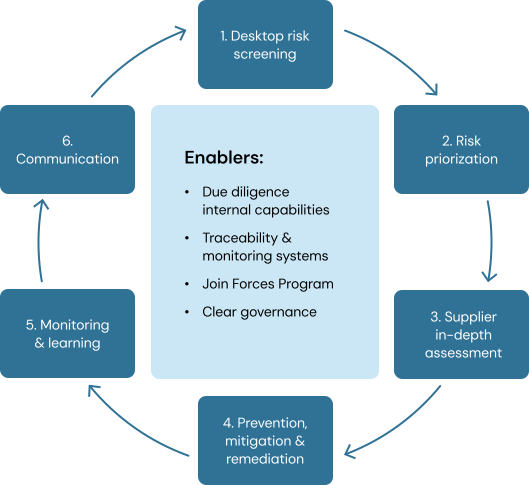
Building on the evolving maturity of our Responsible Sourcing Framework, we also enhanced our Supply Chain Due Diligence Framework in 2025, which formalizes our approach to risk identification and mitigation across the value chain. The framework supports compliance with international standards such as the OECD Guidelines, UNGPs, and Due Diligence regulations. It also enables us to move beyond compliance toward proactive risk management and continuous improvement.
Human rights and labor conditions
Acting on assessment findings, we implemented targeted supplier training programs on human rights, equipping partners with the knowledge and tools to prevent gaps and foster safe, fair workplaces. We also partnered with EcoVadis Ulula to conduct a worker survey at our Apodaca and El Salto sites in Mexico, focusing on facility management services. More information on this can be found in Workers in the value chain.
Key natural ingredients
Our company is committed to sourcing practices that are sustainable and transparent, embedding these principles across all its purchase categories. A new, advanced and comprehensive Responsible Sourcing program for key natural ingredients with a target date of 2030 was launched, combining both desktop and additional field-based assessments to identify salient risks and deploy appropriate mitigation measures.
In 2025, we conducted 54 field due diligence assessments, comprising all planned assessments. Salient risks were identified and action plans defined to address them.
Through this program, the most frequently identified gaps versus our standards relate primarily to social impacts, such as health & safety, working conditions, wages and child labor. More details per focus area will be shared in our annual Human Rights report, which will be published on our website.
We also observed recurrent gaps concerning biodiversity protection, and water and forest management, which remain important priorities for us. See Biodiversity and ecosystems for more details on our ambitions in that area.
Equitable living standards
To accelerate impacts at source, we sponsored the United Nations Global Compact Living Wages initiative and launched pilot projects with three strategic suppliers in Sri Lanka, Colombia, and India. See Workers in the value chain for more details.
Certified raw materials at source
Certification plays a pivotal role in responsible sourcing. It offers transparency, ensures that ingredients are sourced under fair labor conditions and ethical business practices, and minimizes environmental impact. By supporting certification efforts, we mitigate risks and bring positive impact to our supply chains. Our certifications program includes various standards such as RSPO, organic, Fair Trade, Rain Forest Alliance, UEBT among others. In 2025, we increased our sourcing of sustainable raw materials from 20 to 52.
Improvements in sustainability performance
Continuous improvement was once again a priority throughout the year. Suppliers assessed by EcoVadis demonstrated measurable progress, reflected in improved scores and signaling stronger performance and governance. These results validate our approach of combining risk identification with capacity-building and transparent monitoring.
Building procurement capability for responsible sourcing
To advance our commitment to responsible sourcing, we equip every member of our global procurement community with the knowledge and tools to embed sustainability into daily decision-making.
Through a comprehensive training program, our teams deepened their understanding of key topics such as ethical sourcing, human rights, climate impact, and traceability standards. By embedding these principles into their daily business practices, particularly within category management and supplier relationship management, our procurement professionals across the company uphold ethical practices and contribute to long-term sustainable growth.
Joining forces for responsible supply chains
In 2025, we strengthened supplier engagement by delivering capability-building training on Science-Based Targets and Product Carbon Footprint calculation in partnership with the World Business Council for Sustainable Development (WBCSD), empowering suppliers to set and achieve ambitious climate goals.
We also celebrated internal and external achievements through our Procurement and Supplier Sustainability Awards, recognizing exceptional initiatives that promote ethical, impactful, and resilient sourcing practices. In 2025, our internal Procurement award rewarded actions from our naturals sourcing Perfumery & Beauty team. The supplier 2025 award winner will be announced in March 2026.
Furthermore, as an active member of TfS, we leverage shared insights and actions to enhance ESG understanding and drive collective initiatives such as supplier data collection and upskilling.
Our China team actively participated to deliver in-person training with TfS on EcoVadis and Scope 3 Product Carbon Footprint at the China International Petrochemical Conference in Ningbo.
Metrics and targets
As a result of these efforts and actions, our 2025 performance marks a decisive step forward in embedding sustainability across our value chain. We not only met but exceeded all key targets, underscoring the effectiveness of our integrated approach. These results confirm that our strategy is delivering measurable progress and positioning us as a recognized leader in sustainable procurement.
Procurement related Metrics and Responsibly Sourced raw materials |
|
2025 |
|
2024 |
||||||||||
|---|---|---|---|---|---|---|---|---|---|---|---|---|---|---|
Spend coverage with transparency platforms |
|
80.5%1 |
|
68.2% |
||||||||||
Suppliers average EcoVadis score |
|
67.62 |
|
59.7 |
||||||||||
Spend coverage by suppliers with SBTi-validated targets |
|
36.2% |
|
27.9% |
||||||||||
Share of suppliers with human rights risks trained |
|
79% |
|
49% |
||||||||||
Share of procurement staff members trained on responsible sourcing stakes |
|
100% |
|
100% |
||||||||||
Naturals sourcing program completion rate (target of 100% by 2030)3 |
|
48% |
|
-4 |
||||||||||
|
||||||||||||||