
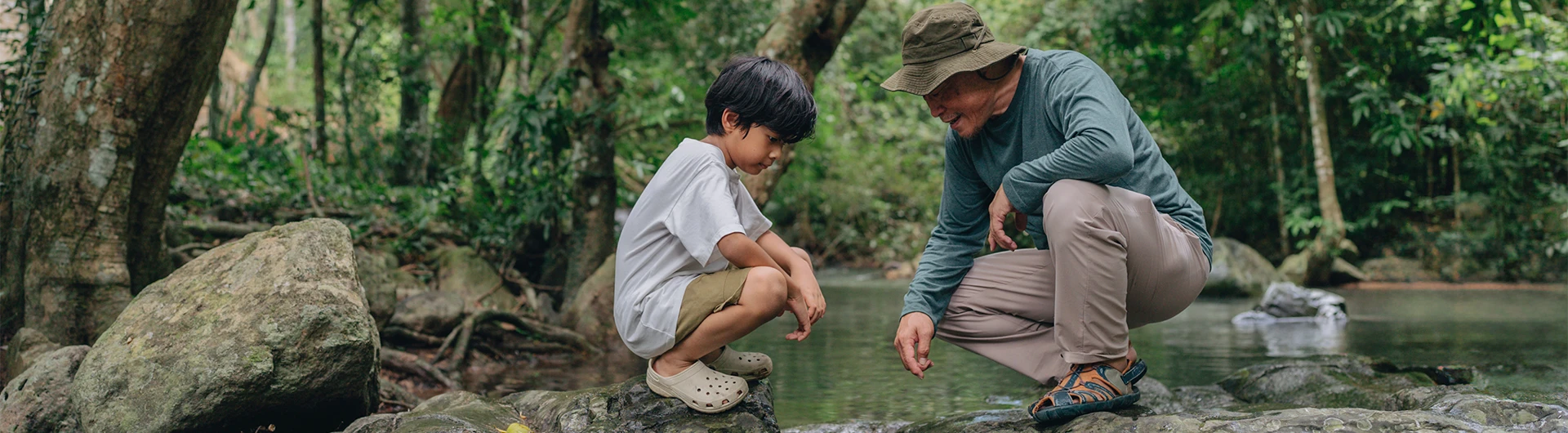
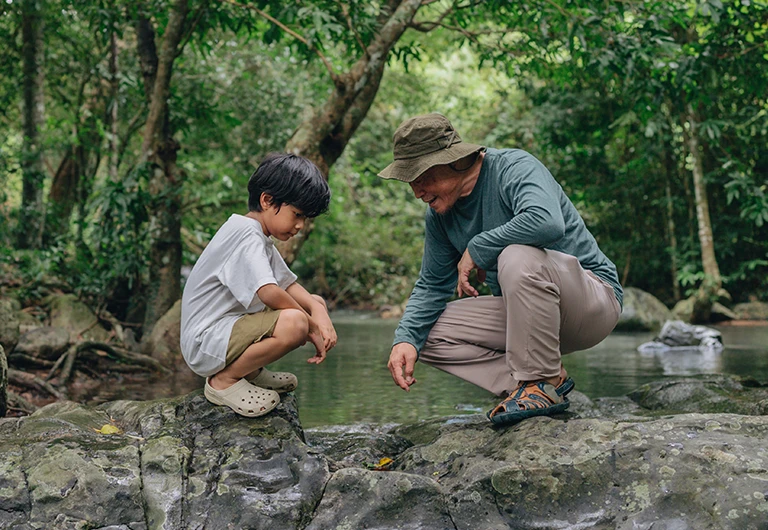
Nature provides critical ecosystem services such as water and biodiversity, essential for producing the ingredients we need today and tomorrow. Nature is also a permanent source of innovation, input, and inspiration for our scientific and creative thinking and plays a crucial role in tackling climate change.
However, biodiversity, or the variety of all living things on our planet, has been declining at an alarming rate in recent years, mainly due to human influences such as changes in land use, pollution, and anthropogenic climate change. Additionally, according to the United Nations (UN), the planet is facing an unprecedented water crisis, with global freshwater demand predicted to exceed supply by 40% by 2030.
Safeguarding nature is critical to the resilience of our business. We rely on nature for resources and ecosystem services in our own operations and our value chains, and conversely, we have an impact on nature through our own operations and our upstream and downstream value chains.
At dsm-firmenich, we help safeguard nature and biodiversity and conserve our planet’s resources by tackling key nature-related challenges across innovation, operations, and priority supply chains and landscapes — working in close collaboration with our suppliers, customers, and partners. We have a long-standing relationship with the International Union for the Conservation of Nature (IUCN), an independent thought leader and advisor. IUCN has supported us in the development of our nature program. The Union for Ethical Biotrade (UEBT) has been our partner since 2013, supporting us in our work to regenerate nature and secure a better future for people through the ethical sourcing of ingredients. We are also a long-standing member of the Roundtable for Sustainable Palm Oil (RSPO). To ensure our work on nature is in line with the evolving landscape of nature-related roadmaps, frameworks and metrics, we closely follow the work of the Taskforce of Nature-related Financial Disclosures (TNFD) and the Science Based Targets Network (SBTN) as well as developments on the part of organizations such as the Nature Positive Initiative and the It’s Now for Nature campaign by Business for Nature. In 2025, we were an active member of the WBCSD Nature Action Imperative, and we have been an endorser of the CEO Water Mandate since 2009.
Supporting services
Without these foundational services, ecosystems could not be sustained. Examples are photosynthesis, soil formation and nutrient and water cycling, but also habitat provision for a range of species.
Regulating services
These moderate natural processes to maintain ecosystem balance, health, and resilience. Examples are pollination, erosion and flood control, carbon storage, and water purification.
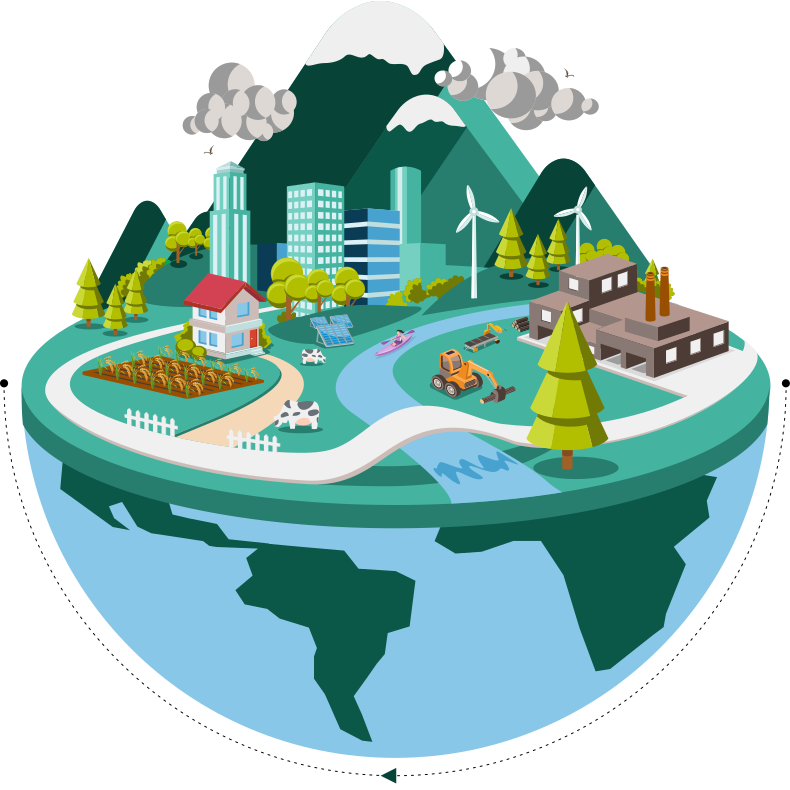
Provisioning services
These are tangible resources or goods obtained from ecosystems. Examples are food, fresh water, medicines, and raw materials.
Cultural services
These provide non-material benefits that enhance quality of life and the human experience. Examples are recreation, tourism, cultural identity, and spiritual, religious, educational, and scientific value.
Strategy
In early 2025, we kicked off a comprehensive nature development program supported by external experts to gain a better understanding of our nature dependencies, impacts, risks, and opportunities (DIROs) for the nature indicators of land use and land use change, water withdrawals, water pollution, soil pollution and biodiversity.
This program aligned closely with the key stakeholders from the Business Units, operations and procurement, It considered the wide variety of different raw materials we source and the locations at which we manufacture to ensure we consider the local impact of nature. The outcome of this program helped us to identify the topics where we can deliver impact both for raw materials and for our operations, focusing on tackling key nature-related challenges across our business.
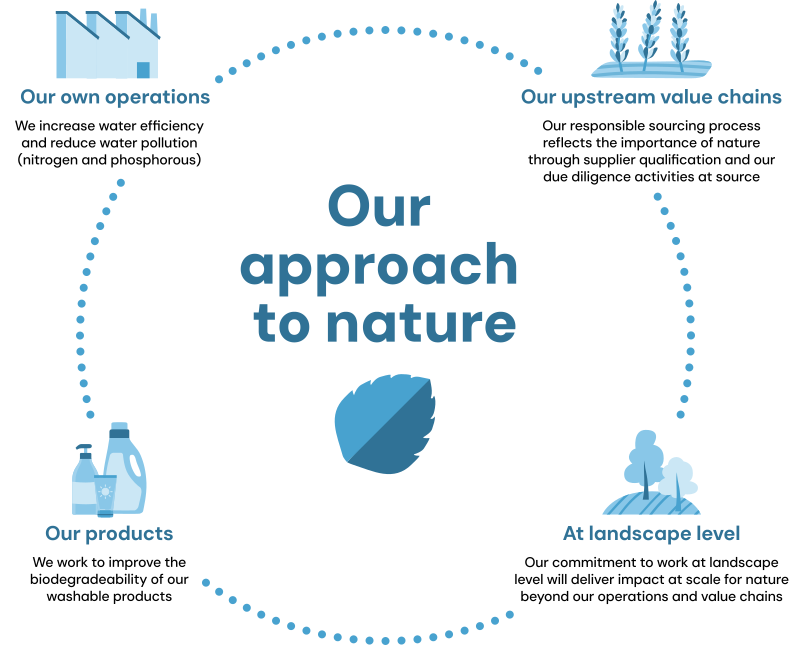
While nature impact through our own operations is under our direct sphere of influence, the products we offer to our customers and the raw materials we source provide a unique opportunity to extend our impact beyond our own operations, tackling nature-related challenges in our upstream value chain, resulting in added value for our customers. Additionally, working at landscape level would allow us to deliver impact at scale on both water and biodiversity beyond our operations and our value chains, ensuring long-term water availability, quality, and ecosystem health. Our approach to nature is outlined in the following paragraphs, and in the accompanying graphic.
Our products: Our product stewardship ambition extends beyond regulatory requirements, transforming our ingredient portfolio to be better compatible with the natural degradation processes. This is reinforced by our biodegradability target
Our own operations: We work to improve the water efficiency of our sites in high water-stressed areas. For all dsm-firmenich sites located in areas with a high water-pollution index, we work to improve our phosphorus and nitrogen efficiency. Both activities are reinforced by targets
Our upstream value chain: Our responsible sourcing process reflects the importance of nature through supplier qualification and our due-diligence activities at source, which is reinforced by our responsibly sourced target for key natural ingredients
At landscape level: The introduction of a broader landscape level ambition would allow us to deliver impact at scale on both water and biodiversity beyond our operations and our value chains, ensuring long-term water availability, quality, and ecosystem health. We therefore commit to start collective action projects in priority landscapes where we operate or source
Impact, risk, and opportunity management
To ensure that we followed a rigorous process consistent with ESRS, the assessment of our nature DIROs was performed in line with the LEAP approach of the Taskforce for Nature-Related Financial Disclosures (TNFD) and followed best practices from SBTN. The definitions, methodology and findings are presented in the accompanying table. The mapping of our disclosures to the TNFD recommendations can be found in the Appendix.
The DIROs are managed through an internal approach that ensures that DIROs are monitored, reviewed on at least a yearly frequency. This approach also ensures integration into our ERM Framework, allowing our businesses to highlight where aspects of the strategy may be at risk and where risk mitigation efforts are required.
Assessment area |
||||||
|---|---|---|---|---|---|---|
Dependencies: These measure how our activities rely on nature through ecosystem services (see infographic on ecosystem services). |
|
Impacts: These measure how our current practices potentially contribute to the degradation of nature. |
|
Nature-related physical risks: These arise when we have activities which are dependent on ecosystem services in locations where ecosystems services are degraded. |
|
Nature-related transition risks: These arise when current business practices are not aligned with activities aimed at protecting, restoring, and/or reducing negative impacts on nature. |
Methodology |
||||||
We measured our dependencies on key ecosystem services by mapping which of our activities are dependent on which ecosystem services. We combined this with our activities (e.g., volume of a raw material sourced from a certain location) and the impact on nature through our activities (e.g., land use, water use). |
|
We measured our impact on nature by evaluating our total pressures on nature, involving a combination of our activities themselves (e.g., volume of a raw material sourced from a certain location) and the impact on nature through our activities (e.g., land use, water use). We then combined this with the state of nature, which is the ecosystem sensitivity in locations where we operate or source raw materials using geospatial data developed by third parties.1 |
|
We assessed which of our activities are dependent on ecosystem services and overlaid this with the current and future state of ecosystem services for a location. Ecosystem services were evaluated for provisioning and regulating and maintenance services. Scenarios were used over various time horizons up to 2050, representing differentiated and plausible futures, based on the IPCC scenarios
|
|
We measured qualitatively considering our activities, locations and narratives on societal developments across a range of scenarios to a time-horizon of 2030. The scenarios used were
|
Findings |
||||||
Own operations: We have ecosystem service dependencies on provisioning services like water supply and regulating services such as water purification. |
|
Own operations: Accounts for 5% of total nature pressure, mostly indirectly (upstream energy and downstream waste). We confirmed that our current water efficiency and pollution targets sufficiently address material pressures. As our footprint is typically in industrialized areas, the greatest biodiversity opportunities lie in collective initiatives beyond our sites. Projects featuring diverse habitats or species, strong local or employee engagement, NGO or community partnerships with regular monitoring are more likely to deliver lasting biodiversity benefits. |
|
Own operations: Sites were assessed for water use, water scarcity, water pollution, freshwater ecotoxicity, and biodiversity. This confirmed that water-related risks are the most relevant. |
|
Several potential transition risks were identified for the upstream value chain and our own operations by 2030. These transition risks spanned the categories of policy and legal, market, reputational, and technological risks. |
We are working to reach compliance with the EU Deforestation Regulation (EUDR), despite the postponement of its entry into force. In 2025, our EUDR project team worked at establishing the systematic due diligence operations triggered for each EUDR-relevant purchase or sales order. Besides this, we worked closely with our suppliers to develop an aligned understanding of the requirements outlined by the EUDR. This also involved engaging with our customers as to the impact of the EUDR on our Responsible Sourcing Standard and commercial portfolio.
Metrics and targets
Through an improved understanding of our nature DIROs, we have developed an approach to take us forward between now and 2030. Our approach to nature addresses nature throughout our business in our products, our own operations, our upstream value chain, and at landscape level, through a combination of (strengthening) existing targets in place and introducing specific new ambitions (e.g., at landscape level).
Our products
We have a target in our sustainability program to achieve 90% ultimate biodegradability for products in washable applications by 2030, based on recognized test methods (OECD 301/302/310 or equivalents). This product innovation and stewardship target guides the transformation of our portfolio toward chemistries that are more compatible with natural degradation processes, helping to reduce the potential accumulation of substances in nature.
In 2025 we achieved 85% ultimate biodegradability for products in the target scope. This is the result of continuous efforts in research and innovation to improve the biodegradability of our product portfolio introduced under the GreenGate program 15 years ago. Our plan to achieve this target is structured around four levers:
High-performance alternative ingredients (for optimized dosage in formula to deliver equivalent or better results)
Regulatory and compliance-driven reformulation (with consideration of better biodegradability)
Discovery of new biodegradable or low-persistence chemistries
Strengthened testing capacity and robustness through AI-enabled predictive models and stewardship infrastructure
Our own operations
Within our own operations, our current targets on water withdrawal and water pollution address our material nature impact. Our target on water efficiency is a 10% improvement for manufacturing sites located in water-stressed areas, between 2023 and 2030. For phosphorous (P) and nitrogen (N) emissions, a company ambition was set to improve P+N efficiency by 20% between 2023 and 2030.
More information on these targets is available in the Water and marine resources section as well as in the voluntary disclosures in the Appendix.
Our upstream value chains
To address the nature impact of our raw materials sourcing, we will build on our existing key natural ingredients responsibly sourced target as part of our sustainability program, by further embedding the outcomes of our nature materiality assessment, specifically with regards to the scope of the key natural value chains and integration of relevant outcomes into the existing due diligence framework. In addition, we will continue to make progress on relevant nature verification and certification requirements through the certification roadmap of our key natural ingredients. An example of an ingredient which is independently verified for biodiversity is patchouli from Indonesia, see our website for more information.
To address our impact on land-use change, we are working on a commitment for deforestation and conversion-free palm oil and derivatives.
At landscape level
To capture the opportunity that was identified for broader collective action in landscapes, we will start collective action projects in priority landscapes where we operate or source.
Biodiversity projects at and around our sites
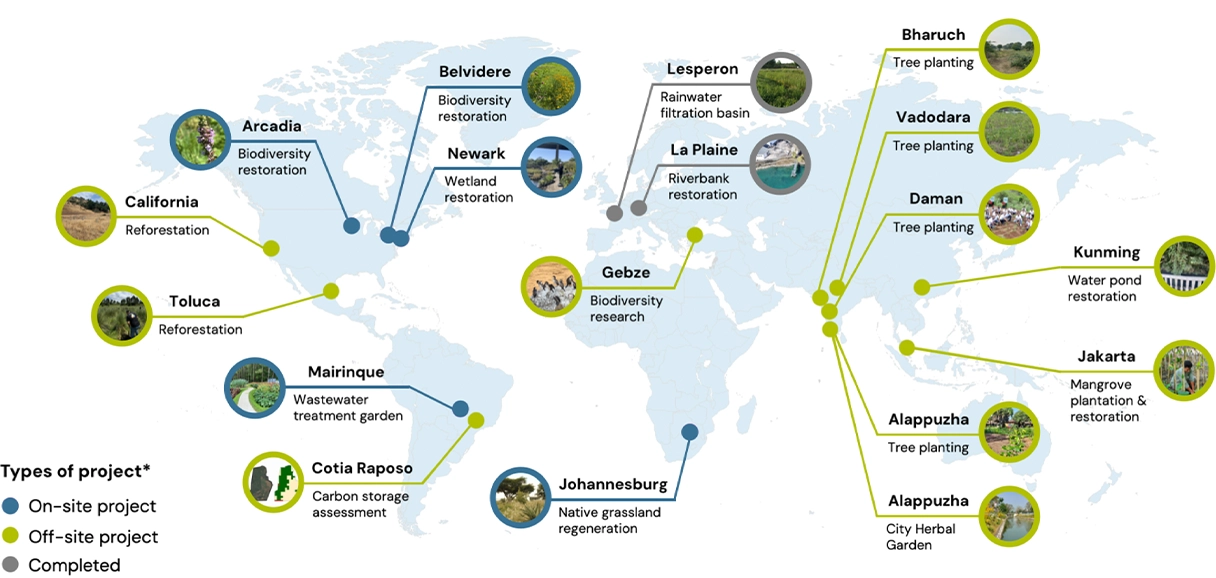
In 2025, we had 16 active site-level biodiversity restoration projects on or around our manufacturing sites worldwide. On-site projects take place inside our operational fence, while restoration activities around our sites go beyond our facilities and operate within a radius of 50 km. The biodiversity projects are managed locally by each site with the participation of local employees and in partnership with external organizations.
Examples of restoration activities are pollinator- and tree-planting, water retention pond installation, river band and riparian corridor restoration. See below for further information on our projects in South Africa and Turkey.
Regeneration of the historically native landscape at the Midrand site in South Africa
Our Midrand site partnered with Marc Sherratt Sustainability Architects (MSSA) to reintroduce native vegetation species into the 1,516 m2 of unused land at the facility, which also includes a ten-year biodiversity monitoring scheme. 2025 is the third year of monitoring. The plants in the restored area were inspected in the summer, when the floristic mix closely matches native vegetation composition. On-site bird diversity is also recorded by a real-time monitoring device.
Regional biodiversity research of Şile district, Turkey
MG International Fragrance Company partnered with the “KuzeyDoğa Society” and three universities to carry out a scientific, participatory, and long-term project aimed at preserving the rich ecosystem of the Şile District, close to our Gebze site. The project was designed to comprehensively document the biodiversity across 250 km2 of area close to our facility, with a special focus on threatened plant species, birds, bats, and wild mammals.
In October 2025, MG International Fragrance Company received the first-ever Biodiversity Award at the Sustainable Business Awards in Turkey, recognizing its voluntary nature conservation project in Şile as one of the most responsible and impactful environmental projects.
Joint nature efforts with Livelihoods Funds
We are a long-standing partner of Livelihoods Funds. The Livelihoods Funds are impact investment funds designed to support the efforts of agricultural and rural communities to live in sustainable ecosystems which serve as the foundation for their food security and provide the necessary resources for their livelihoods.
We invest in The Livelihoods Carbon Funds (LCF). These funds leverage the voluntary carbon market to finance mangrove restoration, agroforestry, regenerative agriculture and rural energy projects with tangible social, environmental, and economic added value for rural communities.
Example projects are agroforestry projects running in India, Guatemala, Mexico, Kenya and Rwanda to rehabilitate forests with income-generating initiatives for local communities, such as intercropping, buffer zone management, and soil health enhancement. Other projects in the funds include mangrove restoration across the coastlines of Indonesia, India and Senegal, moving forward with verifications while reinforcing community engagement. In 2025, we invested 2.6% and 3.0% of total funding in LCF1 and LCF2, respectively, supporting the planting of a total of 20,708 hectares of mangroves and the rehabilitation of 57,092 hectares of land under sustainable practices, along with planting 158.21 million trees, resulting in a CO2 reduction of 5.2 million metric tons.
Site-level biodiversity restoration activities map
Tree planting for both People and Planet
In 2025, we donated a total of 10,465 trees for hours of voluntary learning by our employees (one tree per ten hours of learning), as well as for celebrating the birthdays of our employees at our biomedical manufacturing sites. These trees were planted by Tree-nation in areas ranging across the mangrove restoration coast of Kenya, lost forest recovery in California, boreal forest habitat in Canada, degraded forest of under-resourced communities in Mexico, mangroves and upland forests in Madagascar, and the Amazon Basin in Brazil. Along with tree-planting, 10 hectares of land was reforested, with 360 tonnes of CO2 sequestered by the restored vegetation.