


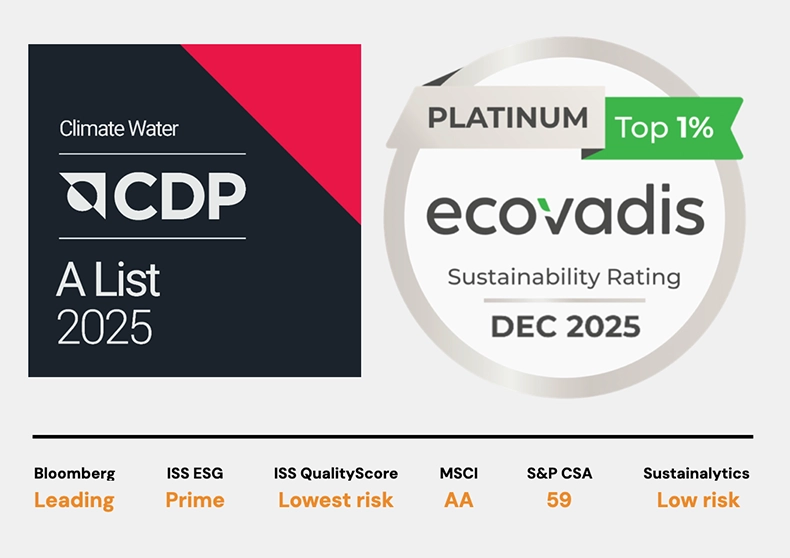
If sustainability were simply a legal requirement, the regulatory uncertainties of the last year could easily have knocked us off our stride. Instead, we held our course. Not only did we launch our new Sustainability program; we were also awarded Climate and Water A-scores from CDP and a Platinum rating from EcoVadis, and we achieved our target of 100% of purchased electricity from renewable sources ahead of time.
“We achieved some remarkable milestones in 2025, reinforced by our new Sustainability program.”
The science on which we base our climate work has not changed. The global rise in natural disasters has simply underscored the importance of continued emissions reductions, and there is a renewed urgency around adaptation. At the same time, sustainability is becoming an increasingly important factor in people’s thinking, whether for investors seeking new opportunities, talent looking for jobs, or consumers weighing up purchasing options.
Our response to these developments has been to stay the course, and we have continued to embed sustainability into our product offering and our decision-making processes. In this Report, you can read more about how our work is bringing progress to life across our value chain, and explore more detailed disclosures in our Sustainability Statements. Both sections demonstrate our company’s commitment to greater transparency and to providing a fuller, more accurate picture of our global footprint.
Our plan rests on three pillars: sustainable performance, value for customers, and impact at scale. We are working to reduce risks and increase our resilience, have designed our new Sustainability program around materiality and customer relevance, and are always looking for ways to use our unique size, reach, and innovation capabilities to drive impact at scale.
By focusing on the value-creation opportunities that sustainability offers, we were able to make meaningful progress towards our targets while also creating lasting value for our business and stakeholders.
People. Planet. Progress
Launched in 2025, our Sustainability program ‘People. Planet. Progress’ concentrates our efforts on areas where we can create the biggest value and impact. It identifies eight focus areas and sets out quantifiable, time-bound targets for achieving them. Among others, these include:
-
Climate: Lowering emissions across our value chain
-
Micronutrient gap: Supporting vulnerable communities worldwide to improve nutrition through our products and solutions
-
Responsible sourcing: Embedding our sustainability ambitions into our sourcing criteria, to drive impact at scale and, significantly, to increase resilience
Delivering on our sustainability ambitions
In 2025, we demonstrated some impressive progress against our targets. Let me mention a few key highlights.
Our environmental performance was strong, and we reduced our Scope 1 & 2 emissions by 31% versus 2021, representing a substantial step forward, enabled by our energy efficiency and renewable energy programs. Our Scope 3 emissions reduced by 23% versus 2021, driven by deepened supplier collaboration and eco-steering as well as reduced procured volumes compared to 2021.
Through a range of programs to reduce the global micronutrient gap, acting both independently and through our partnerships, we have now reached 775 million people, bringing us closer to our ambition of reaching one billion people on an annual basis.
Finally, under our new responsible sourcing program for key natural ingredients, we conducted 54 due diligence assessments and took actions on the salient issues that were identified, corresponding to a 48% completion rate of the program. Further transformation work will be required to reach our 100% target, particularly in complex agricultural supply chains.
You can find more information on how we have performed against all of the targets identified in our Sustainability program later in this section.
A focus on product-level performance
In recent years, the sustainability community has undergone something of a strategic shift. Lofty commitments are giving way to something more pragmatic and action-driven. Top-down, enterprise-level strategies are complemented with a product-level approach that demonstrates value externally while building resilience internally. While the enterprise-level data remains essential for investors, product-level data is increasingly valuable to customers and consumers who want to make more informed choices.
To address this, we embarked on an ambitious digital transformation. While our Business Units already offer market-leading product information – for example, in the way our EcoScent Compass®, EcoFood Compass® and Imp’Act Card™ make sustainability performance transparent to our customers – we felt sustainability lacked its own end-to-end business process. Our new “Innovate to Impact” approach now enables us to build sustainability objectives into our processes from the outset. We also continued efforts to create more efficient and industry-standardized tools for sustainable portfolio steering, including our co-leadership of a dedicated workstream at the World Business Council for Sustainable Development (WBCSD).
Sustainability as a team sport
At the World Sustainability Congress in October, I was asked about organizational enablers for sustainability. I responded that we cannot leave the topic of sustainability to a small corporate team. Genuine progress can only occur if everyone is pulling in the same direction. Only when the CEO, CFO, Chief Procurement Officer, Chief HR Officer, and other functional and business leads are all aligned and equally engaged can sustainability become a truly cross-functional success.
To that end, in 2025 we redoubled our efforts to embed accountability for sustainability delivery into all Business Units and business functions. Our Global Sustainability Leadership Team now acts as the connector, aligning expertise both across our value chain and among our partners, helping to drive impact at scale.
Building a future foundation
As we head into 2026, I am more convinced than ever that the future of sustainability leadership lies in grounding our work in business reality. We have to do more to engage internal teams and external partners. We also need to stress the importance of actions over words and of measuring our impact, as only then will we demonstrate the intrinsic value of sustainability.
Last year, we proved dsm-firmenich is already delivering on that promise. Collaboration has always been the key, as only together can we make an impact at the scale necessary to effect meaningful change. I would like to extend my deepest thanks to all our teams, customers, and partners for making this transformational journey possible.
Katharina Stenholm
Chief Sustainability Officer